Saturday, November 18, 2006
AMD's Multi-Core Not Just Multiple Cores
Hopefully this will put an end to my incessant postings on this topic. It appears AMD is indeed developing a processor with vector units, and using them in their actual processor pipeline instead of using it just for graphics processing. This means their CPU will be able to crunch straight-line algorithms much easier (like Folding@Home) by virtue of a unit on-die that caters to that type of processing.

Monday, November 06, 2006
Evil Creeping At Your Door
It's odd how concommitant my Free Software / Open Source Software experiences have been this week.
I heard Richard Stallman speak at the local law school recently and it was... interesting. I recorded it so I could quote more exactly, but my MP3 player took this opportunity to corrupt the filesystem and junk my recorded files. Nice.
Basically he thinks proprietary software is criminal. He also picks lots of things out of his hair. He also likes to play the recorder to parrots. He also thinks taxing CD media is a good way to subsidize music. I'm not kidding on any of these.
He spoke of the "tivotization" of software - basically digitially signing one's binaries to ensure they're completely tied to a given hardware platform. Linus doesn't care if his kernel is "tivolized" - he's just happy to have people contributing to the kernel however they see necessary. Stallman has vested a lifelong fight against it. He loves to say "GNU + Leeenux" as opposed to just "Linux" as most are accustomed to. Some people believe this is a minor distinction... that Linus' "Open Source Software" is pretty much the same as "Free Software." Wrong - Stallman believes all software should be tinkerable and modifiable, imminently hackable like your car's carburetor. Making something unmodifiable, like not being able to recompile your Tivo's kernel, is like welding your car's hood shut.
Meanwhile, I'm trying to help push Linux adoption at home by having our office adopt SLES 10. No sooner had I received approval than Novell announced their partnership to Microsoft. The divide between Free Software and Open Source Software was cleaved apart even further - now they're on opposite sides of a huge digital divide.
Some see this as an incarnation of Ghandi's famous quote:
But it's not. It's more like "they ignore you, then they laugh at you, then they fight you, then they build up an ominous intellectual property portfolio, then offer indemnity only if you recognize we're right and you're wrong."
As The Register recently pointed out, Novell has effectively become a licensee of Microsoft intellectual property. Now Microsoft can point to SuSE as their "competition in the market," sue the other Linux distros and steer Novell in whatever direction they wish. Now Microsoft has enormous leverage over SuSE, because now Novell can no longer afford to exit the Microsoft deal. The moment they do, Microsoft can litigate the pants off of Novell. Novell has now acknowledged Linux uses Microsoft intellectual property, because they've effectively been given free reign to use said IP by Microsoft. The moment they exit the covenant with Microsoft, they're screwed. Microsoft can always argue that since SuSE had access to their IP, it has to be embedded in their product offering.
Novell will no doubt say they've just entered into a covenant not to sue with Microsoft, and this just allows open source developers to innovate without worry of litigation. But this just doesn't make any sense; Microsoft is paying Novell. Is Novell giving anything in return? No. What this gives Microsoft is their own "blessed" version of Linux, expansion of its intellectual property dominion, and the ability to insert their own "viral licensing."
Microsoft did this once in 1999, by promoting Linux during their antitrust trials. Their trial started the .com bubble bursting, but greatly increased adoption of Linux. Now they're trying to do the same thing for Europe, pointing to their interoperability with SuSE.
And now I need to go find a new Linux distro.
EDIT: I just had to add this quote from a Computer Business Review Online article, taken from Microsoft's chief executive, Steve Ballmer:
If that's not a threat, I don't know what is.
I heard Richard Stallman speak at the local law school recently and it was... interesting. I recorded it so I could quote more exactly, but my MP3 player took this opportunity to corrupt the filesystem and junk my recorded files. Nice.
Basically he thinks proprietary software is criminal. He also picks lots of things out of his hair. He also likes to play the recorder to parrots. He also thinks taxing CD media is a good way to subsidize music. I'm not kidding on any of these.
He spoke of the "tivotization" of software - basically digitially signing one's binaries to ensure they're completely tied to a given hardware platform. Linus doesn't care if his kernel is "tivolized" - he's just happy to have people contributing to the kernel however they see necessary. Stallman has vested a lifelong fight against it. He loves to say "GNU + Leeenux" as opposed to just "Linux" as most are accustomed to. Some people believe this is a minor distinction... that Linus' "Open Source Software" is pretty much the same as "Free Software." Wrong - Stallman believes all software should be tinkerable and modifiable, imminently hackable like your car's carburetor. Making something unmodifiable, like not being able to recompile your Tivo's kernel, is like welding your car's hood shut.
Meanwhile, I'm trying to help push Linux adoption at home by having our office adopt SLES 10. No sooner had I received approval than Novell announced their partnership to Microsoft. The divide between Free Software and Open Source Software was cleaved apart even further - now they're on opposite sides of a huge digital divide.
Some see this as an incarnation of Ghandi's famous quote:
First they ignore you, then they laugh at you, then they fight you, then you win.
But it's not. It's more like "they ignore you, then they laugh at you, then they fight you, then they build up an ominous intellectual property portfolio, then offer indemnity only if you recognize we're right and you're wrong."
As The Register recently pointed out, Novell has effectively become a licensee of Microsoft intellectual property. Now Microsoft can point to SuSE as their "competition in the market," sue the other Linux distros and steer Novell in whatever direction they wish. Now Microsoft has enormous leverage over SuSE, because now Novell can no longer afford to exit the Microsoft deal. The moment they do, Microsoft can litigate the pants off of Novell. Novell has now acknowledged Linux uses Microsoft intellectual property, because they've effectively been given free reign to use said IP by Microsoft. The moment they exit the covenant with Microsoft, they're screwed. Microsoft can always argue that since SuSE had access to their IP, it has to be embedded in their product offering.
Novell will no doubt say they've just entered into a covenant not to sue with Microsoft, and this just allows open source developers to innovate without worry of litigation. But this just doesn't make any sense; Microsoft is paying Novell. Is Novell giving anything in return? No. What this gives Microsoft is their own "blessed" version of Linux, expansion of its intellectual property dominion, and the ability to insert their own "viral licensing."
Microsoft did this once in 1999, by promoting Linux during their antitrust trials. Their trial started the .com bubble bursting, but greatly increased adoption of Linux. Now they're trying to do the same thing for Europe, pointing to their interoperability with SuSE.
And now I need to go find a new Linux distro.
EDIT: I just had to add this quote from a Computer Business Review Online article, taken from Microsoft's chief executive, Steve Ballmer:
"Novell is actually just a proxy for its customers, and it's only for its customers," [Steve Ballmer] added. "This does not apply to any forms of Linux other than Novell's SUSE Linux. And if people want to have peace and interoperability, they'll look at Novell's SUSE Linux. If they make other choices, they have all of the compliance and intellectual property issues that are associated with that."
If that's not a threat, I don't know what is.
Monday, October 23, 2006
Waxing Rhapsodic
This was a week to remember the good ol' days. The early archives of Computer Gaming World was released to the public, harking its imminent rebranding. Be sure and check out the ads... Apple II, DOS 3.2 required. John Romero released the source for all the Quake maps, allowing us to see the actual art and design of each level before it was BSP-fragged. And my vote for the longest running easter egg goes to Nintendo's Totaka Kazumi.
Sunday, October 22, 2006
Nvidia's CPU
Now that ATI and AMD are one, Nvidia is working on a CPU as well. There are a lot of people saying they're working on a "GPU on a chip," but I seriously doubt it. It seems a lot of people are wagering this will go toward the embedded or low-power market, just like when VIA acquired Cyrix. But to do so would be extremely narrow-minded of ATI and Nvidia, even considering the boom of embedded devices and the increasing horsepower needed by set-top boxes.
I'm much more inclined to think that Nvidia is working with Intel (which would be a huge surprise, considering how they've been fighting with SLI on nForce vs. Intel chipsets) to compete with AMD & ATI working on bringing vector processing units to CPU's.
I incessantly bring this topic up, but I had to mention this since it seems that my predictions are actually going to happen. I don't necessarily think this will cause GPU's-on-CPU's to happen, although it might be a by-product. Instead I think this is going to allow for increased parallelization, faster MMX instructions (or 3DNow! if that's your taste) and a movement of putting the work of those physics accelerator cards back on the CPU die.
We may see a CPU with four cores, each with integer and floating point units then a handful of separate vector processors (a la IBM's cell) along side them. Given how the Cell reportedly absolutely sucks for many types of algorithms, this may give developers the best of both worlds. Rapidly branching and conditional logic can be done on the integer units with branch prediction and short instruction pipes while long, grinding algorithms can go to the vector processor. This has already worked for projects like Folding@Home, and could work for many similar algorithms.
Or AMD/ATI and Nvidia could just go for a stupid, embedded GPU's sitting on die with the CPU. But they'd be passing up something much cooler.
ODE to Qt
 I've been working on a small game with Qt and ODE - both cross-platoform APIs that are GPL friendly. While I'm still trying to decide whether or not I like Qt's cross-licensing, I'm definitely sold on its ease of use and elegance of design. And ODE has been great so far... a lot of trial-and-error and late on the 2D scene, but released with a BSD license which makes it very easy to use.
Wednesday, October 11, 2006
AI Modelling Clay
Physics sandboxes have let us play with tossing objects around, particle interactions and launching things across the room. In-game character and model generators let users have fun creating caricatures of ourselves for avatars. So why not have AI sandboxes that let us create weird and wacky AI patterns?
linux.com recently turned me on to N.E.R.O., an interesting title from a university class written with the Torque engine and the open-sourced real-time NeuroEvolution of Augmenting Topologies (rtNEAT) library authored by Kenneth Stanley. If nothing else, it shows why AI can be hard and why current AI in FPS' doesn't seem to "get it" all the time.
Think Moster Rancher meets Creatures and you can kinda get an idea of the attraction. It's definitely in a new "sandbox" genre of its own. It's worth at least 15 minutes of your time... and a free download. The tutorials themselves are worth it.
Sunday, October 08, 2006
To Brew or Not to Brew?
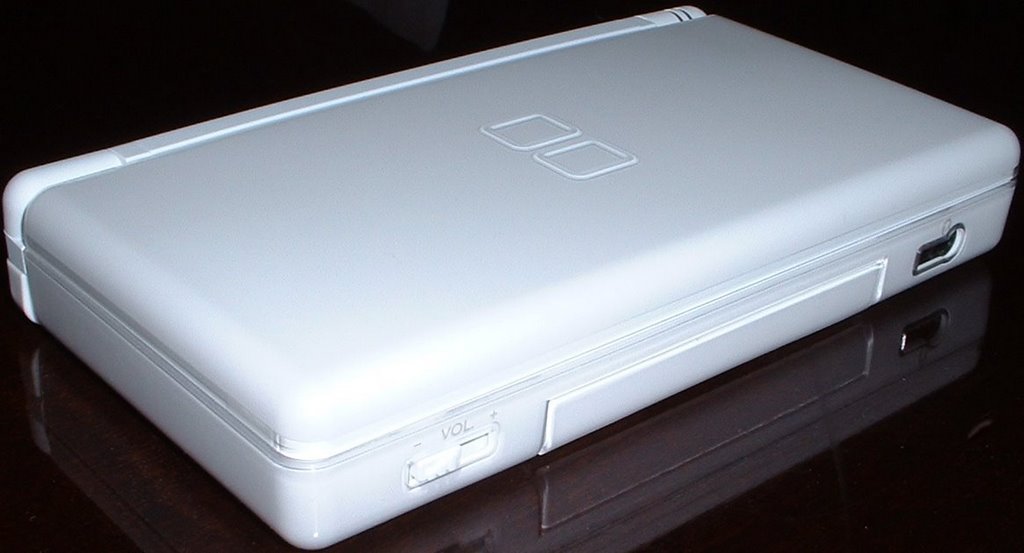
After my recent addition to the family, I've been flogged with writing papers, doing research and trying to emerge as the Prime Minister of Uptime at work (and failing). But I've also been in the midst of a life-affirming decision: to hack my new DS or not to hack it?
Allowing execution of unchecked code isn't as heinous as it was initially - evidentally gone are the days of reflashing one's DS in order to skip the cartridge validation. Now all you needs is one cartridge that passes itself off as "verified" and then allows arbitrary file execution from another source, a second GBA cartridge to act as a flash memory reader, some type of removable flash memory such as MicroSD, and a flash memory interface for one's PC to upload applications to said removable flash device. No more toothpicks wrapped in tinfoil, no more hoping your DS doesn't get bricked. If you're willing to spend yet another $150 you can have a DS that runs homebrew software.
While there are some compelling reasons to run homebrew, I've decided against it. Doubling the price of my DS Lite just isn't worth it, even though the idea of writing software that would run on my DS does give my spine a-tingle. I could argue I'd rather not support cheaters who mod ROM's or warez thieves who distribute them... but that's not necessarily it either. I have this major hangup, where adding too much hardware or doing too many work-arounds because a splinter in my mind. When you have to re-engineer so many things, it becomes too inelegant to be pallatable in my mind.
Now I've seen the DS Lite flash drives, and how they seamlessly merge with the base unit. Truly, a modded DS can be indistinguishable from an unmodded one. But the fact that someone would have to pay double the price for a modded DS is just too much.
That doesn't mean, however, I'd absolutely love to find a way to author my own DS cartridge. If I could find a way to produce a standalone DS cart and upload software to it, I'd be all over that in minutes.
Tuesday, September 26, 2006
Friday, September 22, 2006
DS Development
Out of sheer, morbid curiosity I decided to see what it would take to actually develop an authentic DS cartridge. As the panelists at GDC's Burning Down the House rant suggest, Nintendo is rather tight-fisted with development tools. The process of obtaining development tools requires Nintendo's explicit approval, and it appears none shall pass without a few cartoonish platformers under your belt.
To a point I can understand it... I just wish Nintendo was more open to third-party development. The open-endedness to a myriad of third-party development is what gives Microsoft and Sony all the additional market exposure. They just have none of the schwag. I guess it's Nintendo trying to reinforce their "brand," but if independent developers are supposed to be the saving grace of the games industry, how are they going to keep Nintendo's platforms afloat?
I looked at the technical details of DS cartridges as well as the DS hardware itself, and it seems like it would be a fun platform to develop on. The problem seems to be in the manufacture of the cartridges, and the on-the-fly dynamic encryption the cartridge uses during communication to the unit.
Yes, there is a mature homebrew community for the DS, but that's not what I'm looking for. Getting people to run an installer is tough enough... but trying to have a multitude of people try something that requires a piece of hardware to replace cartridge headers, a flash memory interface, a screwdriver and paperclip crammed into the right hole at the right time is waaaaaaaaaay too much.
Looking at the current state of console homebrew this don't look to rosy on other platforms, either. The PSP requires downgraded firmware but is a bit easier to work with since it aims to be more of a "portable convergent device" than anything else. The other modern handheld platforms... wait... there are none. Well, there's the GP2X which was pretty much designed to be a conduit for independent development, and I respect that, but... well... eh. It just doesn't have the look or immediate marketability to the public at large.
So the bottom line is there's no real chance at marketable, independent game development on the DS. And while it's easier to deploy an independent title to a PSP, it is only narrowly more so. The PSP does have a removable Memory Stick as well as a Web browser, which gives it the advantage of being able to easily move files from a server to the console. But it's still not to the point where you could legitimately sell your indy title on a web site for $5 a pop.
Sunday, September 17, 2006
DS Craving
For the two weeks, ever since Alon retold his story of giving away ten billion DS Lites, I have had an odd, irrational craving to own one. I have no freakin' clue why.
Now that the next round of console wars are coming to a head, I've been watching Wii and PS3 news with tepid anticipation. When I'm at home, I really don't have any free time. But the 12.8 minutes ad must have imbued itself into the part of my brain that rationalizes irrational purchases - because I came to the realization the only console I'd have a chance playing would be a portable one.
Now it's not like I just figured out what a DS is. Or that I was unfamiliar with the titles currently out there. But for some unknown reason a confluence of the form factor, Alon's giveaway and the realization that my time is transient all gave me this unprompted hankerin'. Now all I can think about is how I don't have a DS. I don't even necessarily need one. But dammit... somehow the irrational rationalization neurons are firing in freakin' overdrive.
GAAAAAAAAAAAAAAAHHHHHHHHHHHHH!!!!!!!!!!
I wonder how terrible of a process it is to become an "authorized developer".
Sunday, September 10, 2006
Gamer Shame
I just saw this notice posted for a local school about their computer education program:
So... we're saying video games and movies can't be educational?
Now, I totally realize there's a valid point behind what they're saying. Some parents may let their kids log a little too much time in front of World of Warcraft or ye olde boob-tube. But still, this reinforces a stereotype that video games feed the dregs of society.
In the fantastic Gamasutra Podcast, GDC Radio's Tom Kim interviews Computer Gaming World's Jeff Green. It's a great interview about the media portrayal of the gaming industry, and Tom covers a great topic during a couple of instances: gamer shame.
One thing that Jeff brings up several times is that he's excited that Microsoft's new rebranding efforts, including his relaunched magazine, will start pushing gaming more into the mainstream. Jeff mentions numerous times how he's hoping the new marketing initiative will allow gamers not to "feel like they're shopping in the adult DVD rack" of their local outlet. Jeff brings light to the fact that games often feel like they're being judged while buying games... as if they're doing something unseemly.
It's true. I can't place my finger on why, but it's absolutely freakin' true. Do you know how long it took me to come out of the closet about being an indy game developer?
They mention an New York Times article by Seth Schiesel (forgive me if I got the name wrong) where the industry itself has an image problem - and often doesn't project itself necessarily into the mainstream. Instead, the "hard core" gamers are outsiders, but people who watch "Lost" for eighteen consecutive hours are considered considerably mainstream. Everyone is hardcore about something... just some things are less "geekish" than others.
...goals are accomplished by using age and developmentally appropriate software. No video games or movies are used in the enrichment program.
So... we're saying video games and movies can't be educational?
Now, I totally realize there's a valid point behind what they're saying. Some parents may let their kids log a little too much time in front of World of Warcraft or ye olde boob-tube. But still, this reinforces a stereotype that video games feed the dregs of society.
In the fantastic Gamasutra Podcast, GDC Radio's Tom Kim interviews Computer Gaming World's Jeff Green. It's a great interview about the media portrayal of the gaming industry, and Tom covers a great topic during a couple of instances: gamer shame.
One thing that Jeff brings up several times is that he's excited that Microsoft's new rebranding efforts, including his relaunched magazine, will start pushing gaming more into the mainstream. Jeff mentions numerous times how he's hoping the new marketing initiative will allow gamers not to "feel like they're shopping in the adult DVD rack" of their local outlet. Jeff brings light to the fact that games often feel like they're being judged while buying games... as if they're doing something unseemly.
It's true. I can't place my finger on why, but it's absolutely freakin' true. Do you know how long it took me to come out of the closet about being an indy game developer?
They mention an New York Times article by Seth Schiesel (forgive me if I got the name wrong) where the industry itself has an image problem - and often doesn't project itself necessarily into the mainstream. Instead, the "hard core" gamers are outsiders, but people who watch "Lost" for eighteen consecutive hours are considered considerably mainstream. Everyone is hardcore about something... just some things are less "geekish" than others.
Saturday, September 09, 2006
Random Product Announcements
Among some recent product announcements that I found interesting:
Ubisoft is evidentally releasing a game based more on social interaction, rather than headshots. This may show that studios may finally be considering a gender more interested in strategy and social engineering than normal maps on chainguns.
Hack a Day got me mildly interested in Chumby. I have no real idea what the hell it is, but it appears to be imminently hackable. It's what attracted me to the Squeezebox, and that's proven to be a pretty sound investment.
One more corny Nintendo Wii catchphrase: the "Wiimake". Wiimake? Get it?!?!? HA!
Thursday, September 07, 2006
Exactly How Many PCI-E Slots Does One Need?
I'm pretty much hammering this subject into the ground, but then again so are component makers.
Recently we saw Ageia's physics accelerator come to market as an add-on expansion card, astride your existing video accelerator and sound card. Next we saw the Killer NIC reviewed by IGN, a "network interface accelerator" which promises to offload the assembly of TCP and UDP packets to take load off the CPU. It's actually an embedded Linux instance, assembling your TCP stack instead of Windows. Windows just sends the Killer NIC raw datagrams, then the Killer NIC does all the work to disassemble the datagrams into bare signals over the wire.
Now there's supposedly an accelerator in the works, the Intia Processor, dedicated to nonplayer character AI acceleration. It would offload AI processing from the CPU and instead have a dedicated API for pathfinding, terrain adaptation and line-of-site detection.
So let's count the possible gaming accelerators here:
Sound (i.e. Sound Blaser X-Fi)
Video (i.e. NVIDIA GeForce)
Video (additional NVIDIA GeForce for SLI)
Physics (Ageia PhysX)
Networking (Killer NIC)
AI (Intia Processor)
So that eats at least six slots, but if you have double-wide video cards, more like eight. Oh yeah, and you'll spend nearly $1,500 on just the above hardware accelerators alone.
This is a cycle that repeats itself in the computer world, tho. Popular software algorithms become API's. API's become baked into hardware. The hardware becomes to inflexible and becomes firmware. The firmware isn't flexible so it goes into software. And on and on we go.
But this hasn't necessarily happened for OpenGL or graphics acceleration. Why? Because there you're not baking an API into silicon, you're using a different type of processing unit altogether to solve a different genre of problems. Multiple vector processing pipelines can streamline linear algorithms much more effectively that complex instruction set CPU's. The same analogy can be made for floating point units when they were introduced along side elder CPU's that could only handle integer math.
Not only that, we're looking at chip makers shy away from raw clock speeds and instead looking at cramming as many CPU cores as possible on a single die. This allows for every CPU stamped out of the factory to be a multiprocessor machine. Once API's become more threadsafe, this crazy specialized hardware will instead just be an API call sent to one of the four idle CPU's on someone's desktop.
I think the eventual result of this crazy hardwareization (feel free to use that one) is that people are going to want to fit their algorithms into one of three processing units: the CPU pool (by "pool" I mean a pool of processors upon which to dump your asymmetric threads), the VPU (vector processing unit) or the FPU. The CPU & FPU have already become as one but as any C/C++ programmer can attest to, the decision to use integer based math as opposed to floating point math still rests heavily on the programmer's mind.
Given people are already compiling & running applications on a GPU that have nothing at all to do with graphics, it's only a matter of time before chipset manufacturers come up with a way to capitalize on the new general purpose processing unit.
Recently we saw Ageia's physics accelerator come to market as an add-on expansion card, astride your existing video accelerator and sound card. Next we saw the Killer NIC reviewed by IGN, a "network interface accelerator" which promises to offload the assembly of TCP and UDP packets to take load off the CPU. It's actually an embedded Linux instance, assembling your TCP stack instead of Windows. Windows just sends the Killer NIC raw datagrams, then the Killer NIC does all the work to disassemble the datagrams into bare signals over the wire.
Now there's supposedly an accelerator in the works, the Intia Processor, dedicated to nonplayer character AI acceleration. It would offload AI processing from the CPU and instead have a dedicated API for pathfinding, terrain adaptation and line-of-site detection.
So let's count the possible gaming accelerators here:
So that eats at least six slots, but if you have double-wide video cards, more like eight. Oh yeah, and you'll spend nearly $1,500 on just the above hardware accelerators alone.
This is a cycle that repeats itself in the computer world, tho. Popular software algorithms become API's. API's become baked into hardware. The hardware becomes to inflexible and becomes firmware. The firmware isn't flexible so it goes into software. And on and on we go.
But this hasn't necessarily happened for OpenGL or graphics acceleration. Why? Because there you're not baking an API into silicon, you're using a different type of processing unit altogether to solve a different genre of problems. Multiple vector processing pipelines can streamline linear algorithms much more effectively that complex instruction set CPU's. The same analogy can be made for floating point units when they were introduced along side elder CPU's that could only handle integer math.
Not only that, we're looking at chip makers shy away from raw clock speeds and instead looking at cramming as many CPU cores as possible on a single die. This allows for every CPU stamped out of the factory to be a multiprocessor machine. Once API's become more threadsafe, this crazy specialized hardware will instead just be an API call sent to one of the four idle CPU's on someone's desktop.
I think the eventual result of this crazy hardwareization (feel free to use that one) is that people are going to want to fit their algorithms into one of three processing units: the CPU pool (by "pool" I mean a pool of processors upon which to dump your asymmetric threads), the VPU (vector processing unit) or the FPU. The CPU & FPU have already become as one but as any C/C++ programmer can attest to, the decision to use integer based math as opposed to floating point math still rests heavily on the programmer's mind.
Given people are already compiling & running applications on a GPU that have nothing at all to do with graphics, it's only a matter of time before chipset manufacturers come up with a way to capitalize on the new general purpose processing unit.
Sunday, September 03, 2006
My Platforms are Still Supported: New Product Announcements
A few interesting product announcements of note. First, it turns out that Assassin's Creed (which I mentioned earlier for its innovative reflection of reality) isn't going to be a PS3 exclusive after all - it also will have a PC version released. Good news for those of us who don't own, nor plan to own, a console to game on. I've lived in HD for about ten years now, man. Thanks anyway.
To any point, this is fantastic to hear. I was psyched about how this title would handle physics, collision detection and character constraints, and I'm looking forward to picking up a copy.
On a somewhat related topic, SPEC has now released SPECviewperf 9 for Linux. I think this is a fairly big deal - the fact that SPEC believes Linux is a platform that can handle actual intense rendering shows a level of confidence in the platform that everyone but NVIDIA has been slow to realize.
Saturday, August 26, 2006
Rampant Flashbacks
I finally watched Carmack's presentation at QuakeCon. He mostly discussed the fun of hacking on new and differnet platforms, how parallelization is inevitable but is also an extreme engineering chore, and open sourcing older engines.
He brought up an interesting point - he mentioned he was suprised that no one has yet launched a commercial game based on one of his GPL'ed engines. At first I thought how... unique it was for him to want someone to capitalize on something he dedicated his life to then gave away for free. Then I started to wonder why that was. True, everyone took the sourced engines and ported it to every platform under the sun. That's nifty. But it is somewhat surprising that no one has launched a commercial game on an engine that's not only free but definitely tried-and-true in the marketplace.
In the latest GDC Radio podcast about marketing departments versus developers, they mention how modding or using an existing engine to prove a game concept is usually a quick way to demo something and prove a game function. Carmack also talks about that, mentioning how the mod community is very important and can realize all sorts of gameplay without the huge R&D. However, he also mentions that mods are (or at least their total conversion counterparts) are becoming increasingly rare, probably because the emphasis has now shifted to content creation, and without a team of artists it takes exceptionally long to generate good looking content.
It's interesting to sit back and watch the trials of the CrystalSpace community and how it mirrors... or at least proves... the difficulties in independant game development. They recently had their first international developer conference, and it was interesting the topics that were discussed. It seems like only in the past year has the emphasis really been content creation and building working demos. The engine is absolutely fantastic, but now it's the sweat and tears of taking a title the rest of the way. Take a look at the projects page for CrystalSpace and compare that to the number of titles actually completed (or at least still actively maintained). It's tough to get off the ground.
All this talk of the original mod community and Doom made me a bit nostalgic for my roots. For the hell of it I fired up my good ol' Doom installer... and took it for a run.
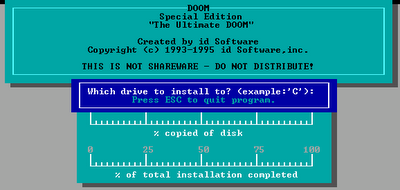
Seeing that ol' DOS installer brought back a rush of old memories... if I closed my eyes I could hear the hum of my Acer 486/66.
He brought up an interesting point - he mentioned he was suprised that no one has yet launched a commercial game based on one of his GPL'ed engines. At first I thought how... unique it was for him to want someone to capitalize on something he dedicated his life to then gave away for free. Then I started to wonder why that was. True, everyone took the sourced engines and ported it to every platform under the sun. That's nifty. But it is somewhat surprising that no one has launched a commercial game on an engine that's not only free but definitely tried-and-true in the marketplace.
In the latest GDC Radio podcast about marketing departments versus developers, they mention how modding or using an existing engine to prove a game concept is usually a quick way to demo something and prove a game function. Carmack also talks about that, mentioning how the mod community is very important and can realize all sorts of gameplay without the huge R&D. However, he also mentions that mods are (or at least their total conversion counterparts) are becoming increasingly rare, probably because the emphasis has now shifted to content creation, and without a team of artists it takes exceptionally long to generate good looking content.
It's interesting to sit back and watch the trials of the CrystalSpace community and how it mirrors... or at least proves... the difficulties in independant game development. They recently had their first international developer conference, and it was interesting the topics that were discussed. It seems like only in the past year has the emphasis really been content creation and building working demos. The engine is absolutely fantastic, but now it's the sweat and tears of taking a title the rest of the way. Take a look at the projects page for CrystalSpace and compare that to the number of titles actually completed (or at least still actively maintained). It's tough to get off the ground.
All this talk of the original mod community and Doom made me a bit nostalgic for my roots. For the hell of it I fired up my good ol' Doom installer... and took it for a run.
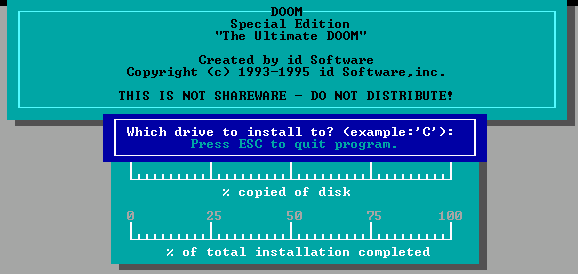
Seeing that ol' DOS installer brought back a rush of old memories... if I closed my eyes I could hear the hum of my Acer 486/66.
Friday, August 25, 2006
GREAT DAY IN THE MORNIN'...
A Penny Arcade eposodic gaming title. I crap you not.
There can be none higher. Everyone, turn in your compilers and heightmaps. The battle has been won. And Gabe and Tycho carry the prize.
There can be none higher. Everyone, turn in your compilers and heightmaps. The battle has been won. And Gabe and Tycho carry the prize.
Thursday, August 24, 2006
Darwinia's Defcon
I was so uber-psyched about Darwinia it was ridiculous. I was hopelessly addicted to Introversion's Uplink, which is still by all measures a great game, I was sure Darwinia was going to be the culmination of my being. Alas, mere weeks after I started playing, I stopped. It just didn't grab my attention enough to warrant stealing away the little free time I have.
Now the press is showing the same ridiculous anticipation towards Defcon (check out the trailers), Introversion's latest brainchild. It seems to keep the same sort of nihilistic layout, UI and score that Uplink had, which is perfect for the isolated, distant war machine they're hoping to portray. But my Darwinia experience keeps me at bay, wondering if they're going to get this one right.
Looks like Uplink with warheads. If that's what it ends up being, this may just be another hit.
A Brief Tangent on Printing
Every so often, there's a weird lil' Windows twitch that I'm called on to support. Here a printer connecting to a Samba print server was taking for-freakin'-ever to spool documents to the remote queue - along the lines of 90 seconds at a time. It wasn't a pause due to an IP resolution or the like... instead Windows was sending massive freakin' amounts of traffic across the line. I'd evesdrop using Ethereal and hear tons of noise... absolute floods of SMB traffic.
I love the Samba listserv posters. I really do. They had traced this back to an issue where Windows XP will open the properties of not just the printer you want to send documents to, but every other printer on the server. Get one bad apple, and you're sent into a backfill of network requests.
Luckily they had found the way to get rid of this brute interrogation by hacking off a few registry keys, which saved the day. But its another minor annoyance that leeched time away until my very being was sucked dry without me noticing.
For those wondering, it was basically just a matter of hacking off the entries in
Back to our regularly scheduled program.
I love the Samba listserv posters. I really do. They had traced this back to an issue where Windows XP will open the properties of not just the printer you want to send documents to, but every other printer on the server. Get one bad apple, and you're sent into a backfill of network requests.
Luckily they had found the way to get rid of this brute interrogation by hacking off a few registry keys, which saved the day. But its another minor annoyance that leeched time away until my very being was sucked dry without me noticing.
For those wondering, it was basically just a matter of hacking off the entries in
HKEY_CURRENT_USER\Printers\DevModePerUser and HKEY_CURRENT_USER\Printers\DevModes2.Back to our regularly scheduled program.
Wednesday, August 23, 2006
Xbox 360 Indie Development?
Rocky pointed me to an interesting announcement (first seen on Gamasutra, then expanded upon later) that Microsoft will be releasing a special "XNA Game Studio Express" - which from what I can gather is a rebranded version of Visual Studio Basic and DirectX bundled together. Their selling point is offering the "XNA Creators Club" for $99 - which sounds something akin to the Microsoft Developers Network (MSDN) for independent game developers.
Now, this would make sense if they allowed you to have an easy-to-use build and test environment for the 360. But instead it appears their way for copying code to the Xbox is uploading all your source and content to the KreatorsKlub, compiling for the 360, then obtaining it via Xbox Live. "Games developed using XNA Game Studio Express cannot be shared through a memory card at this time."
Rebranding Visual Studio, DirectX and an MSDN subscription as the "XNA Game Studio" is kind of a stretch... but hopefully it can lower the entry point of creating a development environment and let people focus on content creation earlier. And as any developer can attest to, establishing a build environment can be excruciating at best.
It is interesting, however, that GarageGames has started promoting its Torque engine for XNA. This can bring a serious producer of indie titles to the 360... and could definitely offer an interesting range of titles (and markets) to Xbox Live. If Microsoft would offer an easier way to test & prototype on the 360, they could see a huge influx of titles, and could easily become the indie hacker's platform of choice.
Saturday, August 19, 2006
Power Equals Work Over Time
 Notice anything missing?
Our friends at Antec have had my PSU for over a week now. It started making a very high-pitched squeal when running, which confirms that the switching circuits (I think) started to go. So I sent it back for an RMA on Friday, and it arrived at Antec's door on Monday morning.
A replacement unit has finally shipped from California last night... but that means it won't be at my doorstep until Wednesday at best. And since my computer lacks any means to provide power to its wonderous self, I'm left with this suck-ass laptop with an ATI card that displays whatever resolution it damn well feels like, forget it if it's an awful 1024x768 on an LCD monitor that has a native resolution of 1280x1024.
Soo... all work that I need to do on my latest "projects" have slowed to a crawl. Crap.
Subscribe to:
Posts (Atom)