Thursday, September 07, 2006

Exactly How Many PCI-E Slots Does One Need?

I'm pretty much hammering this subject into the ground, but then again so are component makers.

Recently we saw Ageia's physics accelerator come to market as an add-on expansion card, astride your existing video accelerator and sound card. Next we saw the Killer NIC reviewed by IGN, a "network interface accelerator" which promises to offload the assembly of TCP and UDP packets to take load off the CPU. It's actually an embedded Linux instance, assembling your TCP stack instead of Windows. Windows just sends the Killer NIC raw datagrams, then the Killer NIC does all the work to disassemble the datagrams into bare signals over the wire.

Now there's supposedly an accelerator in the works, the Intia Processor, dedicated to nonplayer character AI acceleration. It would offload AI processing from the CPU and instead have a dedicated API for pathfinding, terrain adaptation and line-of-site detection.

So let's count the possible gaming accelerators here:
  • Sound (i.e. Sound Blaser X-Fi)
  • Video (i.e. NVIDIA GeForce)
  • Video (additional NVIDIA GeForce for SLI)
  • Physics (Ageia PhysX)
  • Networking (Killer NIC)
  • AI (Intia Processor)

    So that eats at least six slots, but if you have double-wide video cards, more like eight. Oh yeah, and you'll spend nearly $1,500 on just the above hardware accelerators alone.

    This is a cycle that repeats itself in the computer world, tho. Popular software algorithms become API's. API's become baked into hardware. The hardware becomes to inflexible and becomes firmware. The firmware isn't flexible so it goes into software. And on and on we go.

    But this hasn't necessarily happened for OpenGL or graphics acceleration. Why? Because there you're not baking an API into silicon, you're using a different type of processing unit altogether to solve a different genre of problems. Multiple vector processing pipelines can streamline linear algorithms much more effectively that complex instruction set CPU's. The same analogy can be made for floating point units when they were introduced along side elder CPU's that could only handle integer math.

    Not only that, we're looking at chip makers shy away from raw clock speeds and instead looking at cramming as many CPU cores as possible on a single die. This allows for every CPU stamped out of the factory to be a multiprocessor machine. Once API's become more threadsafe, this crazy specialized hardware will instead just be an API call sent to one of the four idle CPU's on someone's desktop.

    I think the eventual result of this crazy hardwareization (feel free to use that one) is that people are going to want to fit their algorithms into one of three processing units: the CPU pool (by "pool" I mean a pool of processors upon which to dump your asymmetric threads), the VPU (vector processing unit) or the FPU. The CPU & FPU have already become as one but as any C/C++ programmer can attest to, the decision to use integer based math as opposed to floating point math still rests heavily on the programmer's mind.

    Given people are already compiling & running applications on a GPU that have nothing at all to do with graphics, it's only a matter of time before chipset manufacturers come up with a way to capitalize on the new general purpose processing unit.
  • Sunday, September 03, 2006

    My Platforms are Still Supported: New Product Announcements

    A few interesting product announcements of note. First, it turns out that Assassin's Creed (which I mentioned earlier for its innovative reflection of reality) isn't going to be a PS3 exclusive after all - it also will have a PC version released. Good news for those of us who don't own, nor plan to own, a console to game on. I've lived in HD for about ten years now, man. Thanks anyway.

    To any point, this is fantastic to hear. I was psyched about how this title would handle physics, collision detection and character constraints, and I'm looking forward to picking up a copy.

    On a somewhat related topic, SPEC has now released SPECviewperf 9 for Linux. I think this is a fairly big deal - the fact that SPEC believes Linux is a platform that can handle actual intense rendering shows a level of confidence in the platform that everyone but NVIDIA has been slow to realize.

    Saturday, August 26, 2006

    Rampant Flashbacks

    I finally watched Carmack's presentation at QuakeCon. He mostly discussed the fun of hacking on new and differnet platforms, how parallelization is inevitable but is also an extreme engineering chore, and open sourcing older engines.

    He brought up an interesting point - he mentioned he was suprised that no one has yet launched a commercial game based on one of his GPL'ed engines. At first I thought how... unique it was for him to want someone to capitalize on something he dedicated his life to then gave away for free. Then I started to wonder why that was. True, everyone took the sourced engines and ported it to every platform under the sun. That's nifty. But it is somewhat surprising that no one has launched a commercial game on an engine that's not only free but definitely tried-and-true in the marketplace.

    In the latest GDC Radio podcast about marketing departments versus developers, they mention how modding or using an existing engine to prove a game concept is usually a quick way to demo something and prove a game function. Carmack also talks about that, mentioning how the mod community is very important and can realize all sorts of gameplay without the huge R&D. However, he also mentions that mods are (or at least their total conversion counterparts) are becoming increasingly rare, probably because the emphasis has now shifted to content creation, and without a team of artists it takes exceptionally long to generate good looking content.

    It's interesting to sit back and watch the trials of the CrystalSpace community and how it mirrors... or at least proves... the difficulties in independant game development. They recently had their first international developer conference, and it was interesting the topics that were discussed. It seems like only in the past year has the emphasis really been content creation and building working demos. The engine is absolutely fantastic, but now it's the sweat and tears of taking a title the rest of the way. Take a look at the projects page for CrystalSpace and compare that to the number of titles actually completed (or at least still actively maintained). It's tough to get off the ground.

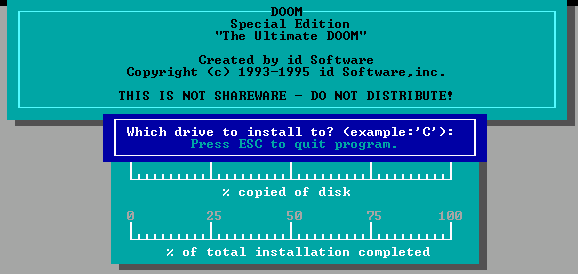
    All this talk of the original mod community and Doom made me a bit nostalgic for my roots. For the hell of it I fired up my good ol' Doom installer... and took it for a run.


    Seeing that ol' DOS installer brought back a rush of old memories... if I closed my eyes I could hear the hum of my Acer 486/66.

    Friday, August 25, 2006

    GREAT DAY IN THE MORNIN'...

    A Penny Arcade eposodic gaming title. I crap you not.

    There can be none higher. Everyone, turn in your compilers and heightmaps. The battle has been won. And Gabe and Tycho carry the prize.

    Thursday, August 24, 2006

    Darwinia's Defcon

    I was so uber-psyched about Darwinia it was ridiculous. I was hopelessly addicted to Introversion's Uplink, which is still by all measures a great game, I was sure Darwinia was going to be the culmination of my being. Alas, mere weeks after I started playing, I stopped. It just didn't grab my attention enough to warrant stealing away the little free time I have.

    Now the press is showing the same ridiculous anticipation towards Defcon (check out the trailers), Introversion's latest brainchild. It seems to keep the same sort of nihilistic layout, UI and score that Uplink had, which is perfect for the isolated, distant war machine they're hoping to portray. But my Darwinia experience keeps me at bay, wondering if they're going to get this one right.

    Looks like Uplink with warheads. If that's what it ends up being, this may just be another hit.

    A Brief Tangent on Printing

    Every so often, there's a weird lil' Windows twitch that I'm called on to support. Here a printer connecting to a Samba print server was taking for-freakin'-ever to spool documents to the remote queue - along the lines of 90 seconds at a time. It wasn't a pause due to an IP resolution or the like... instead Windows was sending massive freakin' amounts of traffic across the line. I'd evesdrop using Ethereal and hear tons of noise... absolute floods of SMB traffic.

    I love the Samba listserv posters. I really do. They had traced this back to an issue where Windows XP will open the properties of not just the printer you want to send documents to, but every other printer on the server. Get one bad apple, and you're sent into a backfill of network requests.

    Luckily they had found the way to get rid of this brute interrogation by hacking off a few registry keys, which saved the day. But its another minor annoyance that leeched time away until my very being was sucked dry without me noticing.

    For those wondering, it was basically just a matter of hacking off the entries in HKEY_CURRENT_USER\Printers\DevModePerUser and HKEY_CURRENT_USER\Printers\DevModes2.

    Back to our regularly scheduled program.

    Wednesday, August 23, 2006

    Xbox 360 Indie Development?

    Rocky pointed me to an interesting announcement (first seen on Gamasutra, then expanded upon later) that Microsoft will be releasing a special "XNA Game Studio Express" - which from what I can gather is a rebranded version of Visual Studio Basic and DirectX bundled together. Their selling point is offering the "XNA Creators Club" for $99 - which sounds something akin to the Microsoft Developers Network (MSDN) for independent game developers.

    Now, this would make sense if they allowed you to have an easy-to-use build and test environment for the 360. But instead it appears their way for copying code to the Xbox is uploading all your source and content to the KreatorsKlub, compiling for the 360, then obtaining it via Xbox Live. "Games developed using XNA Game Studio Express cannot be shared through a memory card at this time."

    Rebranding Visual Studio, DirectX and an MSDN subscription as the "XNA Game Studio" is kind of a stretch... but hopefully it can lower the entry point of creating a development environment and let people focus on content creation earlier. And as any developer can attest to, establishing a build environment can be excruciating at best.

    It is interesting, however, that GarageGames has started promoting its Torque engine for XNA. This can bring a serious producer of indie titles to the 360... and could definitely offer an interesting range of titles (and markets) to Xbox Live. If Microsoft would offer an easier way to test & prototype on the 360, they could see a huge influx of titles, and could easily become the indie hacker's platform of choice.

    Saturday, August 19, 2006

    Power Equals Work Over Time

    Notice anything missing?

    Our friends at Antec have had my PSU for over a week now. It started making a very high-pitched squeal when running, which confirms that the switching circuits (I think) started to go. So I sent it back for an RMA on Friday, and it arrived at Antec's door on Monday morning.

    A replacement unit has finally shipped from California last night... but that means it won't be at my doorstep until Wednesday at best. And since my computer lacks any means to provide power to its wonderous self, I'm left with this suck-ass laptop with an ATI card that displays whatever resolution it damn well feels like, forget it if it's an awful 1024x768 on an LCD monitor that has a native resolution of 1280x1024.

    Soo... all work that I need to do on my latest "projects" have slowed to a crawl. Crap.

    Wednesday, August 09, 2006

    The Enigma of TV Movies

    Have you (or your significant other) ever been sitting on the couch, mindlessly watching an edited-for-network-TV movie, replete with commercials, even though you own the same, unedited, high-definition, 5.1 audio movie in your DVD collection? You may even offer to drop said DVD into the strategically placed player, mere inches below above TV, only to be stopped short because "they're just watching it because its on." Because it would be silly to watch it if it wasn't on.

    It the very same enigma that means the living room PC will never take off, as so observed by Slate. A media center PC would mean finding the remote, switching to the right input on the set, navigating through a few menus, deciding on an option, then actually hitting play. The alternative is randomly navigating channels until you find a Full House rerun. Whilst you may have a more edifying experience with the former, the cerebellum would rather turn itself completely off and opt for the latter.

    It's also the same reason why Internet Explorer owns the majority share of all browser traffic, in spite of its awesome list of well-observed glitches. It's why so many people play solitare on their PC. Hell, it's why Windows won the OS war. It's just on. It's already there, and installing/inserting something different would require the cerebellum to turn back on, and unfortunately 50 hours of mind-numbing tomfoolery at the office has beaten it unconscious.

    If one wants to penetrate the vast sea of casual gamers out there, you have to make something easier to aquire than finding a DVD and watching it on the TV. Why are Flash games so popular? Bingo. Easier than a DVD.

    Mebbe the next frontier isn't the game per se... it's the installer. Direct into your brain. Or whichever pieces of it remain working.

    Friday, August 04, 2006

    Distributed Development

    Gamasutra recently released the conclusion to their two-part interview with John Baez, whose company The Behemoth created the 2D title Alien Hominid.

    The interview largely focuses on how a small, naive start-up was able to "make it" (albeit still without making a profit) and the lessons they learned. They have even been able to make distributed development work - with two offices, and even individual developers, on opposite sides of the country.

    It's an interesting contrast to the current "small companies don't have a chance in hell" talk that is currently floating around. Admittedly, The Behemoth serves a largely niche market, but they're fine with that. And they're still paying salaries. A company has gone alone, taken a title that no one wanted to touch, written it with decentralized developers, and published a title to the PS2, GameCube and 360. They also have merchandising to go along with it, banking on some very original intellectual property.

    12.8 Minutes of Gaming

    In the August 2006 Reader's Digest (shut up) I noticed the following ad on the penultimate page...


    This ad for the Nintendo DS then goes on to push Brain Age, Nintendogs, Magnetica and True Swing Golf. Brain Age being, of course, the latest rage for casual gamers 30 and over.

    It was interesting on several levels: a) this was in freakin' Reader's Digest, b) this was the first overt marketing pitch that I've seen specifically targeting the 30+ crowd, which of course is the demographic that not only is the most plentiful but has the most purchasing power and c) This is obviously Nintendo getting ready to position itself (quite intelligently) not on raw horsepower, but on gameplay and ease-of-use. This is in direct contrast to Sony and Microsoft, and stands to turn decades of console marketing on its ear.

    Given how peeps not unlike myself are relegated to just a few spare moments a week, this could be the key to not only courting a new demographic, but changing the types of titles. AAA games will still have their niche, but it's back to being about the gameplay instead of beautifully rendered shrapnel.

    Sunday, July 30, 2006

    Everybody Loves a Spore

    I've been kinda harping on procedurally and user-generated content as the salvation of the Earth for a while, but I hadn't conceived of how our good friend Will Wright has taken it to the next level. It's beyond procedural content, beyond user-generated content... it's now "pollinated content."

    The GDC was where several interesting Will Wright innovations were unveiled... such as the sure-to-be-a-AAA-title USBEmily. But he also presented an early demo of several gameplay prototypes and fortold of thousands upon millions of objects, each procedurally generated and user defined, wrapped up into 3K files and archived by a massive database.

    This massive database of every player's creations would rank, sort and weigh each item and make it asynchronously available to every other player's universe. You could then "shop" for creations you like, browse archives and even automatically populate your space with balanced flora and fauna automagically pulled from other users.

    This just struck me recently when waxing rhapsodic about Creatures, a game I was way addicted to back in the good ol' college days. There the strength of the game was creature building with learning & adaptive AI, breeding and genetic algorithms. It was quite cool and allowed for much procedurally and user generated content, which players loved to post to fan sites. So you'd browse fan sites, find Norns or DNA strands you liked, download 'em, hack the game, install them, then relaunch. Here, Will is streamlining the entire process: browsing, collecting and installing them is the game.

    I know this is old news for many people out there... but the thing that really got me thinking about it was a recent article in Business Week. Yup, Business Week. Will's idea is making huge splashes in the business side of gaming; think about it: you're now having your user base become your artists, transferring all rights for their creations directly to you. They make the stories, the artwork, the worlds. And these creatures and structs aren't just limited to encounters in your game space... they transcend the digital world into cross-marketing with card games as well.

    For those of you keeping count: Spore is a minigame, Pac-Man clone, RTS, 3rd person adventure (i.e. Diablo-style gameplay), creature builder, construction sandbox (i.e. SimCity), social game (i.e. The Sims), and action card game. Lessee... Will has basically covered every genre fanatically devoured by casual and hardcore gamers alike. You couldn't make Spore more addictive if you laced it with crack.


    Speaking of which... I never knew Robin Williams was a big FPS fan. My friends... I give you the figurehead of our emergent demographic.

    Tuesday, July 25, 2006

    Hiding in an Onion from Big Brother

    Personal security and confidentiality has become something of an item to white hats nowadays. With the Internet allowing for the rapid dissemination of information and speech, an untapped capability to free connected citizens of more oppressive regimes now exists where it didn't before. However, the big shots aren't interested in grass-roots democracy, they'd like cash instead.

    Indeed, even resident democracies are putting random bystanders on government watch lists and performing unmonitored surveillance at large.

    Of note is a particular instance when a few ABC News reports were tipped off that their cell phones were being monitored to track down anonymous sources for investigative stories. That they were being monitored wasn't particularly surprising, but what caught me off guard was how they were subsequently astroturfed en masse. The blog post was so quickly riddled with newspeak one has to wonder how quickly the machine is trying to spread.

    The current environment has raised more than a few eyebrows. Security and privacy tools have taken on new and innovative roles. Phil has stepped up and created Zfone for securing voice communications in an interoperable way between VoIP clients. Scatterchat has really hit the mainstream, using both encryption and onion routing to create a secure channel for IM while still maintaining interoperability as well. Both options provide a way for communication while providing personal protection against evesdropping. Although, one could make the argument that using encryption at all could put you on the list of suspicious persons.

    To be honest, I was hesitant to make this post. I know more and more employers and agencies are monitoring people's blogs to ascertain their relative "risk". I realize that this isn't supposed to be an opinion blog per se, and largely I've avoided political topics other than intellectual property issues. Consider this a brief tangent from my larger mission.

    But just the fact that I was somewhat afraid to make this post... doesn't that say something about the current state of affairs?

    AMDTI? ATIMD? The Vector and the CPU

    I hate to say I told you so, but...

    AMD and ATI are now one. It's the talk of the town: AMD has taken over ATI, to make... umm... AMDTI?

    The hardware ramifications aren't well known... who knows if this will spawn a new core-logic chipset, a new southbridge, a new means of fabricating ATI/AMD procs, new GPU's and physics accelerators, or just new marketing. However... if the core reason they've joined together is for intellectual property, we may start to see some vector units in CPU's. Who knows.

    From my perspective, this smells like a bad deal. ATI's Linux support, while existant, is shallowly so. One need only to try to manage a dual-screen setup or hack an xorg.conf file to realize how kaboshed ATI's Linux driver support is. Contrast it to the robustness of Nvidia's unified driver model and there is simply no comparison. Nvidia wins by not inventing their own wacky configuration schema, but instead streamlining their X11 integration with the mainline accepted standards and augmenting it only when necessary.

    And yet, AMD has proven to be a big Linux supporter. So maybe their ingestion of ATI will be a driving force for them to get their collective butts in gear. Here's to hoping ATI will be the big winner of all this, and that they get in line with AMD's more competitive practices.

    Wednesday, July 19, 2006

    The Next Evolution in Gameplay

    Earlier this year, students at the DigiPen Institute of Technology submitted a game to 2006 Independent Games Festival which is still causing people to rethink gameplay. Their senior project, Narbacular Drop, relied on a unique way of placing portals around a maze to navigate from one end to another. It's a physics-y puzzle game at its heart, and was extremely innovative.

    Our favorite physics-loving company, Valve, caught notice and had the team start porting the game to its Source engine. And now it appears that Valve is adding this game to Half-Life 2: Episode 2.

    Of course, soon as Valve started showing of the game (see it yourself via YouTube or GameVideos), the sites became abuzz. The Ars Technica article says it all: "[The] video makes my brain hurt in all the right ways."

    Mixing this with the right physics toys would definitely make a very innovative physics game... or FPS... or... anything. It's one of those ideas that sends ripples throughout the industry - expect to see this sort of portal-play popping into games as soon as developer's grubby little neurons can wrap around the coding. And really, the coding has got to be clever... just think of the math you'd have to perform in order to get a recursive portal to render.

    Tuesday, July 18, 2006

    Much Work To Do... Before Making Absolutely No Progress

    Aight... so here's how my ConsultComm development schedule goes:

    1. Get coffee
    2. Make change to fix some bug due to a tweak I made in NetBeans 5.0
    3. Find way to fix things so RPM builds work correctly
    4. Spend 30 minutes trying to work around SourceForge problems that have existed since the dawn of ages
    5. Spend another 30 minutes uploading files and publishing new beta revision
    6. Mark bugs as closed, send e-mails
    7. Rinse, repeat

    So... for point releases only 20-40% of my time is spent actually writing code. Kinda drives you batty after a while.

    But, if anyone is inclined, take the latest beta release for a test drive.

    Sunday, July 16, 2006

    From the Desk of DeckerEgo


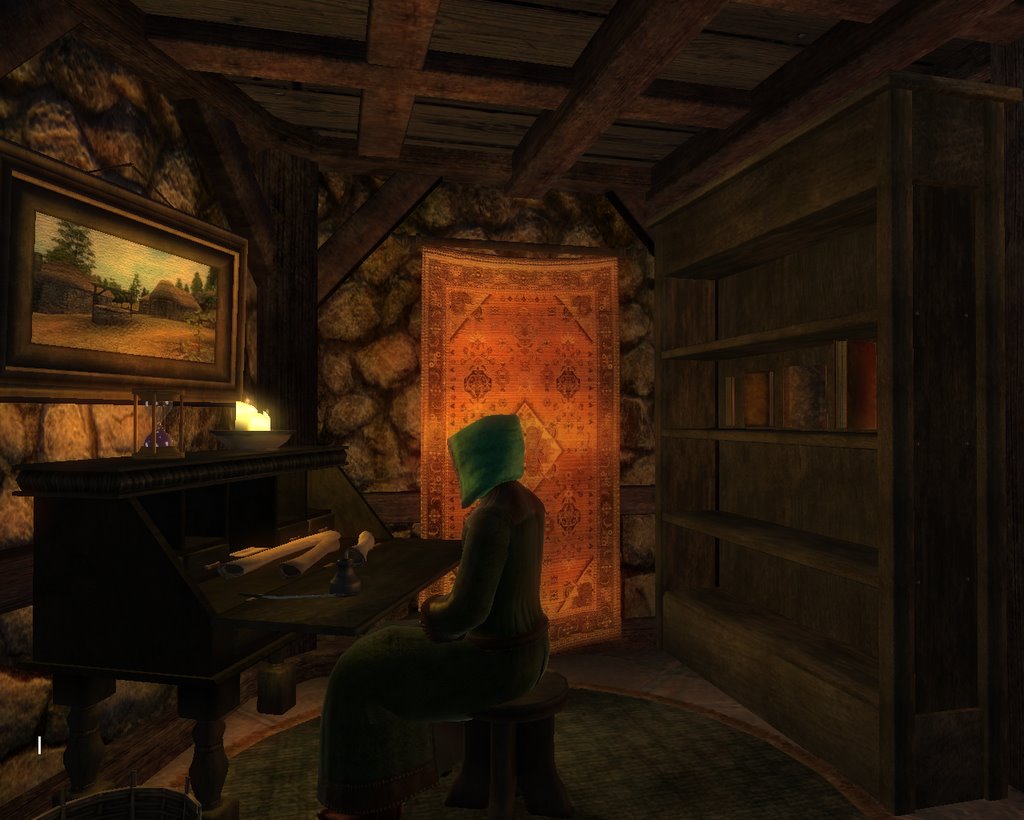
    Inspired by GEV Episode 16 and the soon-to-be-Oprah-book-of-the-month auteurs Mike and Brad, my Oblivion alter-ego bought a nice little nook in Cheydinhal, decorated the space with some books & undulating Daedric artifacts, and is settled in for a bit of a hiatus.

    I'm finishing up my work on some OSS projects and settling down for work on more CrystalSpace projects. I really only have about three hours of open time a week... and I'm falling waaaaaaaaaay behind...

    Tuesday, July 11, 2006

    Obviously Unpatentable

    How non-obvious should something be in order for it to be patented? Can you patent someone clicking a button to buy something on the Web? Can you patent keeping score in a game?

    Most would say not, but so far the USPTO has disagreed. Some fairly "obvious" patents have made their way through the courts, such as alternate ways of swinging on a swingset. The current methodology appears to be "grant every patent, cull the fee, if someone wants to litigate grant a review, cull the fee, then make motions to remove it if need be, whilst culling the fee."

    I know, I know, I've lectured on this verbosely before, but it's something that can completely screw over a small business that happens to out-innovate companies with in-house counsel. That's why I found it interesting that the Supreme Court is hearing KSR International Co. v. Teleflex, Inc., et al. As several sites (news.com for one) have noted, this is a case on how "obvious" a patent should be. Specifically this covers KSR's gas pedal technology... but people are already seeing an immediate connection to technology.

    With common law like this in the books, small business would still... aw, who am I kidding... they would still get smashed like grapes. But at least officeless companies that simply go on a USPTO filing spree can be knocked around by those with the resources to do so. Perhaps this will provide some with the means to overturn the blatantly obvious (and littered with prior art) patents currently on file.

    Take a look at who has filed amicus briefs already. Hmmmmm.....

    Sunday, July 09, 2006

    Boxing Kicked My Butt

    Waaaay back at the inception of this blog I wanted to start working on some proof-of-concept game, mainly to try my hand at physics and collision detection. I didn't even really want to get into art and animation at the time - I was more into the code. My first thought was a quick boxing demo, since I could wrap collision detection, reactive animations and ragdoll physics into it.

    Generally when I learn, I like to place what I learned into this huge document that has become the source for the tutorials I post. And since I had to learn how to build meshes to be collided upon, the first chunk of my tutorials was how to build sprite meshes.

    So I began mesh building. Once I found out MakeHuman meshes were a bit too detailed, I started to build my own. Nine months later I found out how mesh building wasn't something that could be glossed over; I had to figure out the hard way how crucial concept art and reference images were. I didn't even get to scratch the surface of texture building... just building and animating meshes kicked my butt.

    Since I had a newfound respect for concept art and texture building, I figured I'd better learn a thing or two about art concepts. That's what started me down the current track of learning the fundamentals of drawing, so I have concept art to use as reference images for my meshes. And maybe learn a thing or two about colors and textures for my UV maps.

    So, for those of you just tuning in, boxing -> coding -> mesh building -> reference photos -> concept art -> drawing classes. Basically I'm having to take grade school art classes in order to figure out how to build meshes, and get me back on track to where I was eighteen months ago.

    Even given all the work I've put into building the foundations of my lil' demo, I'm considering ditching it all for a change in focus. It seems there's a budding new game genre that would accomplish my earlier goals much more readily: physics toys. GameTunnel's review of June's independent games had two interesting titles that piqued my curiosity: Soup Toys and Armadillo Run. I haven't played them since they're Windows apps... but both are something of physics sandboxes, not unlike World of Sand. One is more of a "desktop distraction" (like AMOR), the other one is more of a standalone engineering challenge. Both are compelling as something as a logic puzzle, but has the draw of Legos or building blocks. In a high-brow physics sort of way, of course.

    Games that can easily be jumped into, run in a standalone window and can soak up just a few minutes of spare time are perfect for the current generation of casual gamers. Mixing that with the appeal of a physics toy is a pretty clever idea. And it would definitely bring me closer to my original goal of a collision detection and physics proof-of-concept demo...

    Friday, July 07, 2006

    Fighting for a Job

    It's interesting to see how people "in the biz" have offered advice on how to get into the gaming industry. Ever since Kenn Hoekstra first wrote his article (which used to be hosted at Ravensoft's Web servers) on "Getting A Job In The Game Development Industry", several developers, project managers and have jumped in to offer their advice, including Tom Sloper's "Game Biz Advice". Just recently Chris Avellone offered insight on what employers actually look for nowadays and Steve Bowler retold his anecdotes to talk about how to stay in the industry.

    It does seem that the ages-old mantra of getting in at the ground level may not apply nearly as much as it used to, at least to hear recent accounts of bug hunters. But there are several points that seem to reoccur:

  • Be professional. You aren't applying to be a lifeguard at the community pool. Treat this like a real job, because it is. Evidentally 90% of the people fail at this task.
  • An impressive portfolio and experience is better than a degree.
  • Don't have an AOL e-mail address.
  • Know people in the industry. Shine their shoes.
  • Don't beg. Make people think, at least until you land a job, that you have some dignity.
  •